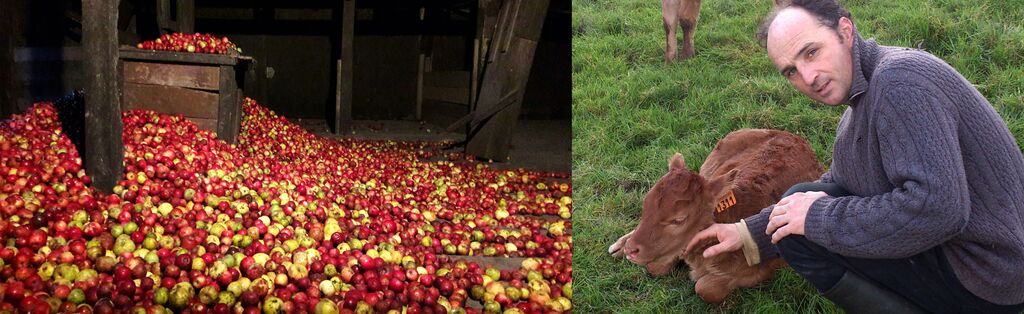
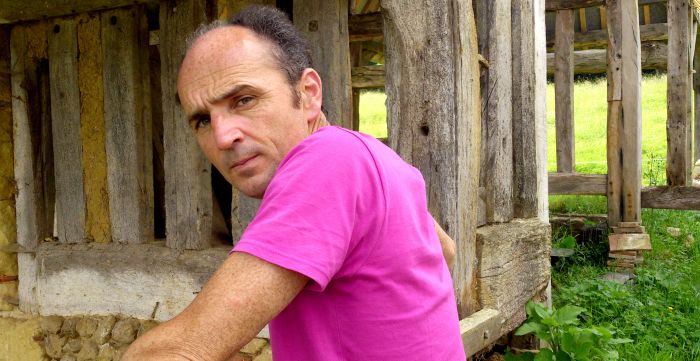
<p>Julien Frémont works in a breathtakingly beautiful farm in the <span class="zalup"><span><glossary title="767">Pays d’Auge</glossary><span>.</span></span></span> This is Camembert and Livarot country, and of course <glossary title="294">cider</glossary> and <span class="zalup"><span><glossary title="226">Calvados</glossary><span>,</span></span></span> a place where cows and apple trees have defined the landscape for more time than can be remembered. It is green, lush, softly hilly, the soil rich <glossary title="301">clay</glossary> with <span class="zalup"><span><glossary title="455">silex</glossary><span>,</span></span></span> and the climate humid and mild.</p>
<p>Frémont says that he would gladly do without his cows, about 80 when you count the youngsters born each year, and just deal with apple trees and the <glossary title="294">cider</glossary> he makes from them. But he knows that cows and trees take care of each another, that his trees would not grow and age the way they do, or his apples taste the same, without the cows.<br />
<br />
The farm has 45<strong> </strong><glossary title="523">hectares</glossary> of grazing fields, 15 of which are planted with apple trees. The cows mow the grass, <glossary title="834">prune</glossary> the trees in summer and eat the fallen apples until it’s time for <glossary title="521">harvest</glossary> from late September until November. The apples are picked by hand in large baskets, then put into 50kg bags. The trees are a mix of old local varieties of acidic, late ripening apples.<br />
<br />
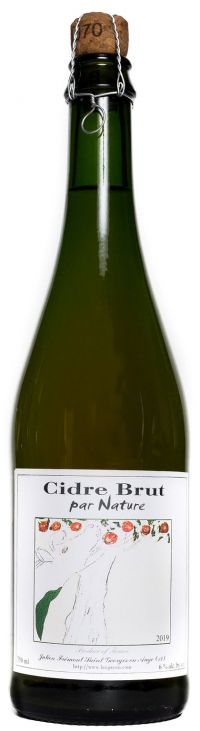
The apples are washed and sorted, then <glossary title="827">pressed</glossary> in the press Frémont's ancestors built in 1765. Some juice is immediately <glossary title="185">bottled</glossary> for apple juice, and the <glossary title="700">must</glossary> for <glossary title="294">cider</glossary> is put in large <glossary title="1140">vats</glossary> where <glossary title="441">fermentation</glossary> starts. It is essential for <glossary title="441">fermentation</glossary> to go slowly, mainly thanks to natural early winter cold, and <span class="zalup"><span><glossary title="843">racking</glossary><span>.</span></span></span> When the alcohol reaches about 4.5%, the <glossary title="700">must</glossary> is <glossary title="185">bottled</glossary> so that the <span class="zalup"><span><glossary title="938">secondary fermentation</glossary><span>,</span></span></span> creating the fizz, can start. This bottling is called <glossary title="202">Brut</glossary> par nature.<br />
<br />
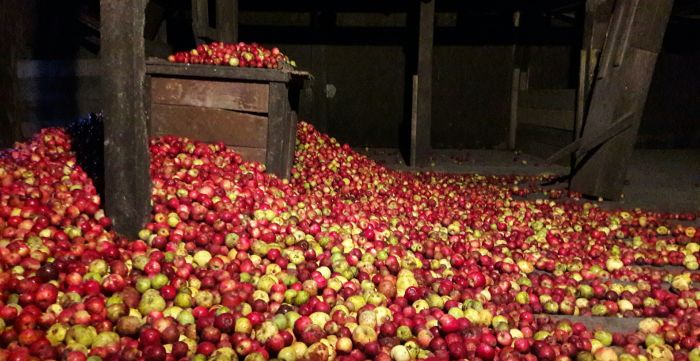
A selection of apples comes from a particular orchard of old trees. Those are kept in the well-ventilated attic for several months, and <glossary title="763">passerillage</glossary> occurs, where the apples dry out and the sugar levels concentrate. When these are <glossary title="827">pressed</glossary> and <span class="zalup"><span><glossary title="441">fermented</glossary><span>,</span></span></span> they make a special <glossary title="185">bottling</glossary> called "Greniers" (attics).</p>
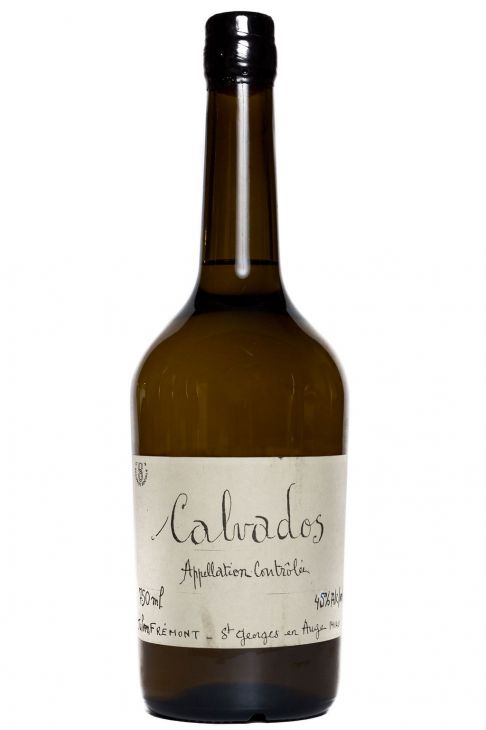
<p>A fantastic <glossary title="226">Calvados</glossary> is also produced and highly sought after. </p>
<p><em>This interview with Julien Frémont took place on his farm in June, 2012.</em></p>
<p><strong>Tell us about your farm.</strong><br />
<br />
The farm consist of 40 <span class="zalup"><span><glossary title="523">hectares</glossary><span>:</span></span></span> 15 of orchards, 25 of pasture. We're located in the <span class="zalup"><span><glossary title="767">Pays d'Auge</glossary><span>,</span></span></span> a natural micro-region in <span class="zalup"><span><glossary title="722">Normandy</glossary><span>.</span></span></span> This land is full of valleys; it's a land of water, which is why it's so green! The grass feeds my cows well, and this great <glossary title="1026">terroir</glossary> lets them produce our famous cheeses like Cambembert. We're also well known for our many apples trees. We have a rich history here: my family bought this farm in 1759, and we've always produced <glossary title="294">cider</glossary> and raised cattle. I personally got involved at a very young age.<br />
<br />
<strong>The farm used to be a lot bigger. Can you tell me about the shift to a smaller scale?</strong><br />
<br />
In the 18th and 19th century, the way a farm like ours did business was very different. My ancestors were already making <glossary title="294">cider</glossary> and <span class="zalup"><span><glossary title="226">calvados</glossary><span>,</span></span></span> but they would sell entire <glossary title="142">barrels</glossary> to restaurants and cafés. These started losing popularity as table drinks, as traditions like coffee with <glossary title="226">calvados</glossary> started to fade (blame the cops for that one!) So we had to figure out a new way to sell our product; my father was the one who restarted <glossary title="394">distilling</glossary> apples, with which he created a stock that he let age 10 and 15 years. He then <glossary title="185">bottled</glossary> them and started selling them directly on the farm, so he's the one who started <glossary title="185">bottling</glossary> and selling independently. This was on a tiny scale, but eventually our reputation grew.<br />
<br />
I took over 15 years ago, and thanks to some connections I'd made through <glossary title="1089">vignerons</glossary> friends, most notably Jean Foillard, I was introduced to a network of restaurants and cafés in Paris. Jean told me to load up a truck of samples, and that he'd introduce me to all his bistro buddies that might be interested in the type of <glossary title="294">cider</glossary> I was making. And that's what we did; we visited Tonneaux des Halles, Le Baratin, Caves Augé... We visited a whole bunch of places that introduced me to the Parisian market, and this eventually led to expanding our sales internationally. <br />
<br />
<strong>Before our visit, I was thinking about your presence at the Dive Bouteille, and was wondering what your connection to the wine world was.</strong><br />
<br />
It was simply meeting a bunch of people who were on the same wavelength. It's actually the <glossary title="1089">vignerons</glossary> who decided it would be nice to have a good <glossary title="294">cider</glossary> at the <span class="zalup"><span><glossary title="395">Dive</glossary><span>,</span></span></span> since they like to drink it. And it's nice to see restauranteurs who taste and suddenly realize that it would be a good idea to have a nice <glossary title="294">cider</glossary> on their list. In the end, I work the exact same as anyone at the <span class="zalup"><span><glossary title="395">Dive</glossary><span>,</span></span></span> and that was the general idea of having me there. And now it feels totally normal that I'm there every year. <br />
<br />
<strong>How did you meet Jean Foillard? </strong><br />
<br />
By complete chance. I was doing a <glossary title="521">harvest</glossary> at some guy's who wasn't at all in our world of wine. We finished up and I wanted to keep going somewhere else. He told me that knew of a clique of guys in the <glossary title="151">Beaujolais</glossary> who took forever to finish their <glossary title="521">harvest</glossary> because they <span class="zalup"><span><glossary title="520">hand harvested</glossary><span>!</span></span></span> So I showed up and worked Régis Foillard's <span class="zalup"><span><glossary title="521">harvest</glossary><span>,</span></span></span> where I met his brother Jean. The way he worked was atypical and very interesting to me; I got a good feeling from him and we instantly hit it off.<br />
<br />
<strong>How did technology vs. tradition play out on your farm?</strong><br />
<br />
There are much more conformist ways to make <span class="zalup"><span><glossary title="294">cider</glossary><span>.</span></span></span> The way I learned, there was an <glossary title="422">oenologist</glossary> who swung by the <glossary title="254">cellar</glossary> all the time: he'd taste, then tell me put this many grams of that and that many grams of this… I quickly felt a disconnect working this way, because it was some guy giving me the same recipe over and over. This isn't my approach towards existence, and I got bored very fast. I then started meeting people like the <glossary title="1089">vignerons</glossary> we were just talking about, and I realized that I was completely free to make <glossary title="294">cider</glossary> the way I wanted to make it. So I didn't rehire my <span class="zalup"><span><glossary title="422">oenologist</glossary><span>,</span></span></span> and decided to make less protected and dryer <span class="zalup"><span><glossary title="294">ciders</glossary><span>,</span></span></span> because the <glossary title="767">Auge</glossary> <glossary title="108">AOC</glossary> is restricted to a very sweet style. What I've slowly realized is that you don't have more or less problems working the way I do. The guys who choose to over-protect their <glossary title="294">ciders</glossary> have just as many issues as I do, they're just different. There is no fool-proof guarantee against imperfections. <br />
<br />
<strong>Can you talk about your choice to of pressing and co-fermenting different apples at the same time based on their ripening period? </strong><br />
<br />
I combine certain apples to create a single juice, contrary to many producers who create many single variety juices to blend into a final juice that will then <span class="zalup"><span><glossary title="441">ferment</glossary><span>.</span></span></span> So if one of their juices is marked by <span class="zalup"><span><glossary title="71">acidity</glossary><span>,</span></span></span> the idea is to to <glossary title="168">blend</glossary> it with one that will soften it, etc… But here we are lucky enough to really know our apple varieties because we've been working with them for so long; we already know what happens when one variety is <glossary title="168">blended</glossary> with another, so we can confidently combine them together before they are <glossary title="827">pressed</glossary> for their juice. It's a particularity, an individual choice. <br />
<br />
<strong>Can we talk about your A.O.C and where you find yourself within it?</strong><br />
<br />
The <glossary title="108">A.O.C</glossary> is a system that has done a lot of good for many regions. We are indeed in a natural region called the <span class="zalup"><span><glossary title="767">Pays de l'Auge</glossary><span>,</span></span></span> and an <glossary title="108">A.O.C</glossary> exists for it; but like any other <span class="zalup"><span><glossary title="108">A.O.C</glossary><span>,</span></span></span> it was formed with pre-defined ideas, by a group of producers who have dictated production methods. This has less to do with a place and more to do with politics and <span class="zalup"><span><glossary title="422">oenologists</glossary><span>.</span></span></span> For example, in <glossary title="767">Auge</glossary> a <glossary title="294">cider</glossary> has to be <glossary title="386">demi-sec</glossary> because in their minds, only a <glossary title="386">demi-sec</glossary> <glossary title="294">cider</glossary> is emblematic of the region. <br />
<br />
I used to make <glossary title="108">A.O.C</glossary> <span class="zalup"><span><glossary title="294">cider</glossary><span>.</span></span></span> They were good, and I continue to taste delicious <glossary title="767">Auge</glossary> <glossary title="294">ciders</glossary> from my colleagues. But there was a point where I felt strange that I was auto-restraining myself by following guidelines. Why can't I make a <glossary title="202">brut</glossary> <glossary title="294">cider</glossary> if I want to? I found it rather tragic. Simultaneously, I started meeting all these <glossary title="1089">vignerons</glossary> and restaurant guys who were pushing quality products, and they started asking me if I had a <glossary title="405">dryer</glossary> <glossary title="294">cider</glossary> they could buy from me. When I told them no, and that our high end stuff was on sweeter side, they told me they weren't too fond of that style… So I decided to stop following guidelines. The <glossary title="108">A.O.C</glossary> is not really a world I'm a part of anymore, and I don't really know what's going on with them at this point. All I know is that it wasn't doing it for me. <br />
<br />
<strong>What do you like to drink?</strong> <br />
<br />
I drink a bit of everything. I don't have any real preferences, but I do have a real fondness for anything that sparkles. It's always done me good; if there's bubbles in it, I don't feel like I'm actually drinking alcohol!</p>
producer visit24.09.2020
Julien Frémont Visit
This visit to Julien Frémont took place in Summer 2012
<p><img src="http://louisdressner.com/uploads/images/article/2020_Sep_24//56/61/5661e8cd20de0b33f4095b95d647c6e5.jpg" /></p>
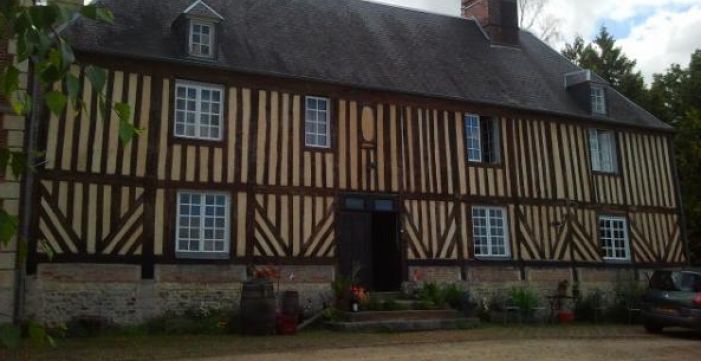
<p>We started our trip out in <span class="zalup"><span><glossary term="Normandy" title="722">Normandie</glossary><span>,</span></span></span> a region we rarely visit. We're staying in the tiny village of Montpinçon, where our friends just celebrated the 20 year anniversary of the country house they rebuilt themselves from scratch.</p>
<p><img src="http://louisdressner.com/uploads/images/article/2020_Sep_24//23/a7/23a72699326f9b827dd02bff547274a5.jpeg" /></p>
<p>On top of all the local <glossary term="Cider" title="294">cider</glossary> and <span class="zalup"><span><glossary term="Calvados" title="226">calvados</glossary><span>,</span></span></span> we drank at least 12 <glossary term="Magnum" title="617">magnums</glossary> of Jean Paul Brun's 2011 "L'Ancien", so you know it was a good party. And since it turns out that we were 10 minutes away from Julien Frémont's farm, it was only natural we go pay him a visit!</p>
<p>After a bit of catch up, we went right to the <glossary term="Cellar" title="254">cellar</glossary> to check out the <glossary term="Cider" title="294">cider</glossary> making process, something I wasn't at all familiar with. The first stop was the attic, where apples are brought up by a pulley system, then sorted for quality. Altogether, it holds up to 20 tons of fruit.</p>
<p>After making their selections (mainly if the apples will be used for <glossary term="Cider" title="294">cider</glossary> or <glossary term="Calvados" title="226">calvados</glossary>), they drop the apples in a hole, leading them straight into a large grater on the ground floor. It literally looks like a huge cheese grater. The apples are mulched, and the resulting pulp is then laid flat into special blankets and stacked one by one on old wooden panels laid on top of each other. It's then time to start a slow, water operated <glossary term="Manual Press" title="1200">press</glossary> which lasts a little over an hour (Julien says they average six to eight of these a day). The juice drops into containers by <span class="zalup"><span><glossary term="Gravity" title="1165">gravity</glossary><span>,</span></span></span> which is then <glossary term="Racking/Soutirage" title="843">racked</glossary> to <glossary term="Wood" title="1126">tonneau</glossary> or <glossary term="Fiberglass" title="445">fiberglass</glossary> containers.</p>
<p><glossary term="Alcoholic Fermentation" title="87">Alcoholic fermentation</glossary> occurs in <glossary term="Barrique" title="144">tonneau</glossary> and <glossary term="Fiberglass" title="445">fiberglass</glossary> containers. The <glossary term="Barrique" title="144">tonneaux</glossary> are all quite large, from 60 to 100<span class="zalup"><span><glossary term="Hectoliter" title="524">hl</glossary><span>!</span></span></span> All of these had to be built in the <glossary term="Cellar" title="254">cellar</glossary> itself because of their massive size. Julien loves the rustic qualities that he gets with the <span class="zalup"><span><glossary term="Barrique" title="144">tonneaux</glossary><span>,</span></span></span> but admits that the <glossary term="Fiberglass" title="445">fiberglass</glossary> is easier to clean and control; by combining both he feels he strikes a proper balance between tradition and technology. Everything is <glossary term="Fermentation" title="441">fermented</glossary> with the <glossary term="Native Yeast" title="538">native yeasts</glossary> on the apples and in the <span class="zalup"><span><glossary term="Cellar" title="254">cellar</glossary><span>.</span></span></span></p>
<p>Unlike wine, where dead <glossary term="Yeast" title="1128">yeasts</glossary> form <glossary term="Lees" title="590">lees</glossary> that sink to the bottom, <glossary term="Fermentation" title="441">fermenting</glossary> apples produce pectins, forming a solid, gelatinous <glossary term="Cap/Hat" title="234">hat</glossary> on the top of the juice. These are naturally lifted to the top by the carbonic gas that occurs during this period. But the same gas eventually punctures the <span class="zalup"><span><glossary term="Cap/Hat" title="234">hat</glossary><span>,</span></span></span> which is the perfect time to start <glossary term="Racking/Soutirage" title="843">racking</glossary> the <glossary term="Cider" title="294">cider</glossary> and get rid of the goo. This process lasts anywhere between eight days and three weeks depending on the weather (the colder it is, the longer it takes).</p>
<p>On average, the <glossary term="Harvest" title="521">harvest</glossary> takes almost two months! This is because Julien grows about 25 varieties of apples and each of them has a unique ripening period. Each <glossary term="Cuvée" title="363">cuvée</glossary> is a <glossary term="Blend" title="168">blend</glossary> of 5-7 apples <glossary term="Co-fermentation" title="308">co-fermented</glossary> together based on a similar ripening periods. This is a rather uncommon way of making <span class="zalup"><span> <glossary term="Cider" title="294">cider</glossary><span>,</span></span></span> as most producers prefer <glossary term="Blending" title="1146">blending</glossary> different juices to balance the final product out: a sweeter one with a drier one, a more acidic one with a less acidic one... (Julien's upcoming interview goes in depth on the philosophy regarding his <glossary term="Blending" title="1146">blending</glossary>).</p>
<p>The apple varieties were all planted at random, but Julien and his team are well trained at knowing which is which. For trees Julien planted in the last 10 years, he planted rows of identical varieties, as well as planting varieties that ripen around the same time next to each other; it's just logistically easier.</p>
<p>According to Julien, the 2011 <glossary term="Cider" title="294">cider</glossary> we tasted is a:</p>
<p><em>"Great compromise of fresh fruit and rustic structure."</em></p>
<p>As far as the farm, it was started in 1750 by his family, and the current <glossary term="Cellar" title="254">cellar</glossary> <span class="zalup"><span>(<glossary term="Barrique" title="144">tonneaux</glossary><span>,</span></span></span> <span class="zalup"><span><glossary term="Manual Press" title="1200">press</glossary><span>,</span></span></span> etc…) dates back to 1900. Making <glossary term="Cider" title="294">cider</glossary> traditionally means a lot more work for Julien, but he claims he'd feel uncomfortable in a "modern laboratory" setting.</p>
<p>He has about 20 cows which are used for beef; up until recently the Frémonts had always produced milk, but this became too much work so Julien decided it was time for a change. The cows take care of the fields by grazing and naturally <glossary term="Fertilizer" title="442">fertilizing</glossary> the ground, which Julien feels is essential to <glossary term="Pays d'Auge" title="767">Auge</glossary>'s unique <span class="zalup"><span><glossary term="Terroir" title="1026">terroir</glossary><span>.</span></span></span></p>
<p>We ended our visit shooting the shit about Julien's connection to the <glossary term="Dive Bouteille" title="395">Dive Bouteille</glossary> (cool story you'll discover in the interview), Catherine and Pierre Breton, the <span class="zalup"><span><glossary term="Beaujolais" title="151">Beaujolais</glossary><span>,</span></span></span> the <span class="zalup"><span><glossary term="Loire Valley" title="602">Loire</glossary><span>,</span></span></span> the South and how each has defined its own style of <span class="zalup"><span><glossary term="Natural WIne" title="708">natural winemaking</glossary><span>.</span></span></span> We also talked about a phenomenon Julien aptly titled, the "consomacteur": people who choose to understand what they consume, to know where something comes from and how it's actually made, who support the actions of those who work in a more traditional way.</p>
<p>A recent visitor, upon seeing the very, how shall I put this, "rustic" <span class="zalup"><span><glossary term="Cellar" title="254">cellar</glossary><span>,</span></span></span> even asked if he was still legally allowed to work this way! It's true: hygiene laws have become stricter and stricter in Europe, and as we all know a <glossary term="Cellar" title="254">cellar</glossary> needs that natural funk to form the <glossary term="Yeast" title="1128">yeasts</glossary> which naturally <glossary term="Fermentation" title="441">ferment</glossary> the wines, cheeses and ciders we all love so much.</p>
<p>The best translation I could come up with for "comsomacteur" is "caresumer", but holy shit does that sound pretentious and corny, so WE ARE NEVER using that term ever. Watch someone use it at some point though... (<strong>ed note:</strong> almost a decade later, I'm knocking on wood to never hear this term used anywhere else). </p>
<p>Julien Frémont works in a breathtakingly beautiful farm in the <span class="zalup"><span><glossary title="767">Pays d’Auge</glossary><span>.</span></span></span> This is Camembert and Livarot country, and of course <glossary title="294">cider</glossary> and <span class="zalup"><span><glossary title="226">Calvados</glossary><span>,</span></span></span> a place where cows and apple trees have defined the landscape for more time than can be remembered. It is green, lush, softly hilly, the soil rich <glossary title="301">clay</glossary> with <span class="zalup"><span><glossary title="455">silex</glossary><span>,</span></span></span> and the climate humid and mild.</p>
<p>Frémont says that he would gladly do without his cows, about 80 when you count the youngsters born each year, and just deal with apple trees and the <glossary title="294">cider</glossary> he makes from them. But he knows that cows and trees take care of each another, that his trees would not grow and age the way they do, or his apples taste the same, without the cows.<br />
<br />
The farm has 45<strong> </strong><glossary title="523">hectares</glossary> of grazing fields, 15 of which are planted with apple trees. The cows mow the grass, <glossary title="834">prune</glossary> the trees in summer and eat the fallen apples until it’s time for <glossary title="521">harvest</glossary> from late September until November. The apples are picked by hand in large baskets, then put into 50kg bags. The trees are a mix of old local varieties of acidic, late ripening apples.<br />
<br />
The apples are washed and sorted, then <glossary title="827">pressed</glossary> in the press Frémont's ancestors built in 1765. Some juice is immediately <glossary title="185">bottled</glossary> for apple juice, and the <glossary title="700">must</glossary> for <glossary title="294">cider</glossary> is put in large <glossary title="1140">vats</glossary> where <glossary title="441">fermentation</glossary> starts. It is essential for <glossary title="441">fermentation</glossary> to go slowly, mainly thanks to natural early winter cold, and <span class="zalup"><span><glossary title="843">racking</glossary><span>.</span></span></span> When the alcohol reaches about 4.5%, the <glossary title="700">must</glossary> is <glossary title="185">bottled</glossary> so that the <span class="zalup"><span><glossary title="938">secondary fermentation</glossary><span>,</span></span></span> creating the fizz, can start. This bottling is called <glossary title="202">Brut</glossary> par nature.<br />
<br />
A selection of apples comes from a particular orchard of old trees. Those are kept in the well-ventilated attic for several months, and <glossary title="763">passerillage</glossary> occurs, where the apples dry out and the sugar levels concentrate. When these are <glossary title="827">pressed</glossary> and <span class="zalup"><span><glossary title="441">fermented</glossary><span>,</span></span></span> they make a special <glossary title="185">bottling</glossary> called "Greniers" (attics).</p>
<p>A fantastic <glossary title="226">Calvados</glossary> is also produced and highly sought after. </p>
<p><em>This interview with Julien Frémont took place on his farm in June, 2012.</em></p>
<p><strong>Tell us about your farm.</strong><br />
<br />
The farm consist of 40 <span class="zalup"><span><glossary title="523">hectares</glossary><span>:</span></span></span> 15 of orchards, 25 of pasture. We're located in the <span class="zalup"><span><glossary title="767">Pays d'Auge</glossary><span>,</span></span></span> a natural micro-region in <span class="zalup"><span><glossary title="722">Normandy</glossary><span>.</span></span></span> This land is full of valleys; it's a land of water, which is why it's so green! The grass feeds my cows well, and this great <glossary title="1026">terroir</glossary> lets them produce our famous cheeses like Cambembert. We're also well known for our many apples trees. We have a rich history here: my family bought this farm in 1759, and we've always produced <glossary title="294">cider</glossary> and raised cattle. I personally got involved at a very young age.<br />
<br />
<strong>The farm used to be a lot bigger. Can you tell me about the shift to a smaller scale?</strong><br />
<br />
In the 18th and 19th century, the way a farm like ours did business was very different. My ancestors were already making <glossary title="294">cider</glossary> and <span class="zalup"><span><glossary title="226">calvados</glossary><span>,</span></span></span> but they would sell entire <glossary title="142">barrels</glossary> to restaurants and cafés. These started losing popularity as table drinks, as traditions like coffee with <glossary title="226">calvados</glossary> started to fade (blame the cops for that one!) So we had to figure out a new way to sell our product; my father was the one who restarted <glossary title="394">distilling</glossary> apples, with which he created a stock that he let age 10 and 15 years. He then <glossary title="185">bottled</glossary> them and started selling them directly on the farm, so he's the one who started <glossary title="185">bottling</glossary> and selling independently. This was on a tiny scale, but eventually our reputation grew.<br />
<br />
I took over 15 years ago, and thanks to some connections I'd made through <glossary title="1089">vignerons</glossary> friends, most notably Jean Foillard, I was introduced to a network of restaurants and cafés in Paris. Jean told me to load up a truck of samples, and that he'd introduce me to all his bistro buddies that might be interested in the type of <glossary title="294">cider</glossary> I was making. And that's what we did; we visited Tonneaux des Halles, Le Baratin, Caves Augé... We visited a whole bunch of places that introduced me to the Parisian market, and this eventually led to expanding our sales internationally. <br />
<br />
<strong>Before our visit, I was thinking about your presence at the Dive Bouteille, and was wondering what your connection to the wine world was.</strong><br />
<br />
It was simply meeting a bunch of people who were on the same wavelength. It's actually the <glossary title="1089">vignerons</glossary> who decided it would be nice to have a good <glossary title="294">cider</glossary> at the <span class="zalup"><span><glossary title="395">Dive</glossary><span>,</span></span></span> since they like to drink it. And it's nice to see restauranteurs who taste and suddenly realize that it would be a good idea to have a nice <glossary title="294">cider</glossary> on their list. In the end, I work the exact same as anyone at the <span class="zalup"><span><glossary title="395">Dive</glossary><span>,</span></span></span> and that was the general idea of having me there. And now it feels totally normal that I'm there every year. <br />
<br />
<strong>How did you meet Jean Foillard? </strong><br />
<br />
By complete chance. I was doing a <glossary title="521">harvest</glossary> at some guy's who wasn't at all in our world of wine. We finished up and I wanted to keep going somewhere else. He told me that knew of a clique of guys in the <glossary title="151">Beaujolais</glossary> who took forever to finish their <glossary title="521">harvest</glossary> because they <span class="zalup"><span><glossary title="520">hand harvested</glossary><span>!</span></span></span> So I showed up and worked Régis Foillard's <span class="zalup"><span><glossary title="521">harvest</glossary><span>,</span></span></span> where I met his brother Jean. The way he worked was atypical and very interesting to me; I got a good feeling from him and we instantly hit it off.<br />
<br />
<strong>How did technology vs. tradition play out on your farm?</strong><br />
<br />
There are much more conformist ways to make <span class="zalup"><span><glossary title="294">cider</glossary><span>.</span></span></span> The way I learned, there was an <glossary title="422">oenologist</glossary> who swung by the <glossary title="254">cellar</glossary> all the time: he'd taste, then tell me put this many grams of that and that many grams of this… I quickly felt a disconnect working this way, because it was some guy giving me the same recipe over and over. This isn't my approach towards existence, and I got bored very fast. I then started meeting people like the <glossary title="1089">vignerons</glossary> we were just talking about, and I realized that I was completely free to make <glossary title="294">cider</glossary> the way I wanted to make it. So I didn't rehire my <span class="zalup"><span><glossary title="422">oenologist</glossary><span>,</span></span></span> and decided to make less protected and dryer <span class="zalup"><span><glossary title="294">ciders</glossary><span>,</span></span></span> because the <glossary title="767">Auge</glossary> <glossary title="108">AOC</glossary> is restricted to a very sweet style. What I've slowly realized is that you don't have more or less problems working the way I do. The guys who choose to over-protect their <glossary title="294">ciders</glossary> have just as many issues as I do, they're just different. There is no fool-proof guarantee against imperfections. <br />
<br />
<strong>Can you talk about your choice to of pressing and co-fermenting different apples at the same time based on their ripening period? </strong><br />
<br />
I combine certain apples to create a single juice, contrary to many producers who create many single variety juices to blend into a final juice that will then <span class="zalup"><span><glossary title="441">ferment</glossary><span>.</span></span></span> So if one of their juices is marked by <span class="zalup"><span><glossary title="71">acidity</glossary><span>,</span></span></span> the idea is to to <glossary title="168">blend</glossary> it with one that will soften it, etc… But here we are lucky enough to really know our apple varieties because we've been working with them for so long; we already know what happens when one variety is <glossary title="168">blended</glossary> with another, so we can confidently combine them together before they are <glossary title="827">pressed</glossary> for their juice. It's a particularity, an individual choice. <br />
<br />
<strong>Can we talk about your A.O.C and where you find yourself within it?</strong><br />
<br />
The <glossary title="108">A.O.C</glossary> is a system that has done a lot of good for many regions. We are indeed in a natural region called the <span class="zalup"><span><glossary title="767">Pays de l'Auge</glossary><span>,</span></span></span> and an <glossary title="108">A.O.C</glossary> exists for it; but like any other <span class="zalup"><span><glossary title="108">A.O.C</glossary><span>,</span></span></span> it was formed with pre-defined ideas, by a group of producers who have dictated production methods. This has less to do with a place and more to do with politics and <span class="zalup"><span><glossary title="422">oenologists</glossary><span>.</span></span></span> For example, in <glossary title="767">Auge</glossary> a <glossary title="294">cider</glossary> has to be <glossary title="386">demi-sec</glossary> because in their minds, only a <glossary title="386">demi-sec</glossary> <glossary title="294">cider</glossary> is emblematic of the region. <br />
<br />
I used to make <glossary title="108">A.O.C</glossary> <span class="zalup"><span><glossary title="294">cider</glossary><span>.</span></span></span> They were good, and I continue to taste delicious <glossary title="767">Auge</glossary> <glossary title="294">ciders</glossary> from my colleagues. But there was a point where I felt strange that I was auto-restraining myself by following guidelines. Why can't I make a <glossary title="202">brut</glossary> <glossary title="294">cider</glossary> if I want to? I found it rather tragic. Simultaneously, I started meeting all these <glossary title="1089">vignerons</glossary> and restaurant guys who were pushing quality products, and they started asking me if I had a <glossary title="405">dryer</glossary> <glossary title="294">cider</glossary> they could buy from me. When I told them no, and that our high end stuff was on sweeter side, they told me they weren't too fond of that style… So I decided to stop following guidelines. The <glossary title="108">A.O.C</glossary> is not really a world I'm a part of anymore, and I don't really know what's going on with them at this point. All I know is that it wasn't doing it for me. <br />
<br />
<strong>What do you like to drink?</strong> <br />
<br />
I drink a bit of everything. I don't have any real preferences, but I do have a real fondness for anything that sparkles. It's always done me good; if there's bubbles in it, I don't feel like I'm actually drinking alcohol!</p>
Article
producer visit24.09.2020
This visit to Julien Frémont took place in Summer 2012
<p><img src="http://louisdressner.com/uploads/images/article/2020_Sep_24//56/61/5661e8cd20de0b33f4095b95d647c6e5.jpg" /></p>
<p>We started our trip out in <span class="zalup"><span><glossary term="Normandy" title="722">Normandie</glossary><span>,</span></span></span> a region we rarely visit. We're staying in the tiny village of Montpinçon, where our friends just celebrated the 20 year anniversary of the country house they rebuilt themselves from scratch.</p>
<p><img src="http://louisdressner.com/uploads/images/article/2020_Sep_24//23/a7/23a72699326f9b827dd02bff547274a5.jpeg" /></p>
<p>On top of all the local <glossary term="Cider" title="294">cider</glossary> and <span class="zalup"><span><glossary term="Calvados" title="226">calvados</glossary><span>,</span></span></span> we drank at least 12 <glossary term="Magnum" title="617">magnums</glossary> of Jean Paul Brun's 2011 "L'Ancien", so you know it was a good party. And since it turns out that we were 10 minutes away from Julien Frémont's farm, it was only natural we go pay him a visit!</p>
<p>After a bit of catch up, we went right to the <glossary term="Cellar" title="254">cellar</glossary> to check out the <glossary term="Cider" title="294">cider</glossary> making process, something I wasn't at all familiar with. The first stop was the attic, where apples are brought up by a pulley system, then sorted for quality. Altogether, it holds up to 20 tons of fruit.</p>
<p>After making their selections (mainly if the apples will be used for <glossary term="Cider" title="294">cider</glossary> or <glossary term="Calvados" title="226">calvados</glossary>), they drop the apples in a hole, leading them straight into a large grater on the ground floor. It literally looks like a huge cheese grater. The apples are mulched, and the resulting pulp is then laid flat into special blankets and stacked one by one on old wooden panels laid on top of each other. It's then time to start a slow, water operated <glossary term="Manual Press" title="1200">press</glossary> which lasts a little over an hour (Julien says they average six to eight of these a day). The juice drops into containers by <span class="zalup"><span><glossary term="Gravity" title="1165">gravity</glossary><span>,</span></span></span> which is then <glossary term="Racking/Soutirage" title="843">racked</glossary> to <glossary term="Wood" title="1126">tonneau</glossary> or <glossary term="Fiberglass" title="445">fiberglass</glossary> containers.</p>
<p><glossary term="Alcoholic Fermentation" title="87">Alcoholic fermentation</glossary> occurs in <glossary term="Barrique" title="144">tonneau</glossary> and <glossary term="Fiberglass" title="445">fiberglass</glossary> containers. The <glossary term="Barrique" title="144">tonneaux</glossary> are all quite large, from 60 to 100<span class="zalup"><span><glossary term="Hectoliter" title="524">hl</glossary><span>!</span></span></span> All of these had to be built in the <glossary term="Cellar" title="254">cellar</glossary> itself because of their massive size. Julien loves the rustic qualities that he gets with the <span class="zalup"><span><glossary term="Barrique" title="144">tonneaux</glossary><span>,</span></span></span> but admits that the <glossary term="Fiberglass" title="445">fiberglass</glossary> is easier to clean and control; by combining both he feels he strikes a proper balance between tradition and technology. Everything is <glossary term="Fermentation" title="441">fermented</glossary> with the <glossary term="Native Yeast" title="538">native yeasts</glossary> on the apples and in the <span class="zalup"><span><glossary term="Cellar" title="254">cellar</glossary><span>.</span></span></span></p>
<p>Unlike wine, where dead <glossary term="Yeast" title="1128">yeasts</glossary> form <glossary term="Lees" title="590">lees</glossary> that sink to the bottom, <glossary term="Fermentation" title="441">fermenting</glossary> apples produce pectins, forming a solid, gelatinous <glossary term="Cap/Hat" title="234">hat</glossary> on the top of the juice. These are naturally lifted to the top by the carbonic gas that occurs during this period. But the same gas eventually punctures the <span class="zalup"><span><glossary term="Cap/Hat" title="234">hat</glossary><span>,</span></span></span> which is the perfect time to start <glossary term="Racking/Soutirage" title="843">racking</glossary> the <glossary term="Cider" title="294">cider</glossary> and get rid of the goo. This process lasts anywhere between eight days and three weeks depending on the weather (the colder it is, the longer it takes).</p>
<p>On average, the <glossary term="Harvest" title="521">harvest</glossary> takes almost two months! This is because Julien grows about 25 varieties of apples and each of them has a unique ripening period. Each <glossary term="Cuvée" title="363">cuvée</glossary> is a <glossary term="Blend" title="168">blend</glossary> of 5-7 apples <glossary term="Co-fermentation" title="308">co-fermented</glossary> together based on a similar ripening periods. This is a rather uncommon way of making <span class="zalup"><span> <glossary term="Cider" title="294">cider</glossary><span>,</span></span></span> as most producers prefer <glossary term="Blending" title="1146">blending</glossary> different juices to balance the final product out: a sweeter one with a drier one, a more acidic one with a less acidic one... (Julien's upcoming interview goes in depth on the philosophy regarding his <glossary term="Blending" title="1146">blending</glossary>).</p>
<p>The apple varieties were all planted at random, but Julien and his team are well trained at knowing which is which. For trees Julien planted in the last 10 years, he planted rows of identical varieties, as well as planting varieties that ripen around the same time next to each other; it's just logistically easier.</p>
<p>According to Julien, the 2011 <glossary term="Cider" title="294">cider</glossary> we tasted is a:</p>
<p><em>"Great compromise of fresh fruit and rustic structure."</em></p>
<p>As far as the farm, it was started in 1750 by his family, and the current <glossary term="Cellar" title="254">cellar</glossary> <span class="zalup"><span>(<glossary term="Barrique" title="144">tonneaux</glossary><span>,</span></span></span> <span class="zalup"><span><glossary term="Manual Press" title="1200">press</glossary><span>,</span></span></span> etc…) dates back to 1900. Making <glossary term="Cider" title="294">cider</glossary> traditionally means a lot more work for Julien, but he claims he'd feel uncomfortable in a "modern laboratory" setting.</p>
<p>He has about 20 cows which are used for beef; up until recently the Frémonts had always produced milk, but this became too much work so Julien decided it was time for a change. The cows take care of the fields by grazing and naturally <glossary term="Fertilizer" title="442">fertilizing</glossary> the ground, which Julien feels is essential to <glossary term="Pays d'Auge" title="767">Auge</glossary>'s unique <span class="zalup"><span><glossary term="Terroir" title="1026">terroir</glossary><span>.</span></span></span></p>
<p>We ended our visit shooting the shit about Julien's connection to the <glossary term="Dive Bouteille" title="395">Dive Bouteille</glossary> (cool story you'll discover in the interview), Catherine and Pierre Breton, the <span class="zalup"><span><glossary term="Beaujolais" title="151">Beaujolais</glossary><span>,</span></span></span> the <span class="zalup"><span><glossary term="Loire Valley" title="602">Loire</glossary><span>,</span></span></span> the South and how each has defined its own style of <span class="zalup"><span><glossary term="Natural WIne" title="708">natural winemaking</glossary><span>.</span></span></span> We also talked about a phenomenon Julien aptly titled, the "consomacteur": people who choose to understand what they consume, to know where something comes from and how it's actually made, who support the actions of those who work in a more traditional way.</p>
<p>A recent visitor, upon seeing the very, how shall I put this, "rustic" <span class="zalup"><span><glossary term="Cellar" title="254">cellar</glossary><span>,</span></span></span> even asked if he was still legally allowed to work this way! It's true: hygiene laws have become stricter and stricter in Europe, and as we all know a <glossary term="Cellar" title="254">cellar</glossary> needs that natural funk to form the <glossary term="Yeast" title="1128">yeasts</glossary> which naturally <glossary term="Fermentation" title="441">ferment</glossary> the wines, cheeses and ciders we all love so much.</p>
<p>The best translation I could come up with for "comsomacteur" is "caresumer", but holy shit does that sound pretentious and corny, so WE ARE NEVER using that term ever. Watch someone use it at some point though... (<strong>ed note:</strong> almost a decade later, I'm knocking on wood to never hear this term used anywhere else). </p>