<p>Loris Follador and his sons Raffaele and Adelchi come from a long line of farmers in <span class="zalup"><span><glossary term="Valdobbiadene" title="1067">Valdobbiadene</glossary><span>.</span></span></span> The family had vines on the steep hillsides when the flat areas of the valley were still pastureland and turnip fields and the main local industry was the nearby pottery and tile factories. Now those flatlands are full of vines, and commercial <glossary term="Prosecco" title="830">prosecco</glossary> with a capital “ P” -that insipid, slightly cloying, and frankly disgusting wine- is the main economy of the region.</p>
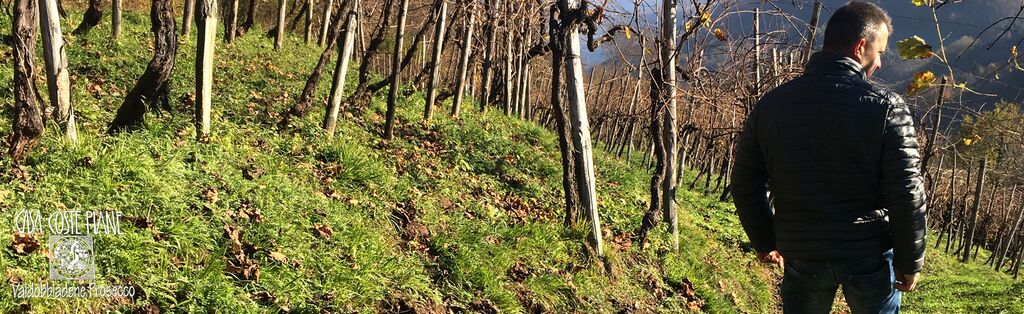
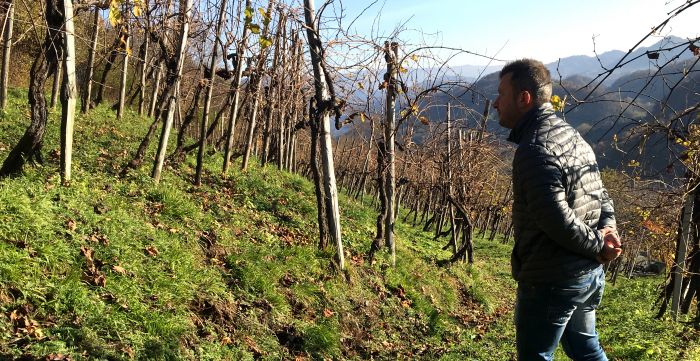
<p>Thanks to his father and grandfather, Loris and his two sons have never had to plant a vine. This is a good thing because their vineyards are absurdly steep and the soil is very shallow, hitting solid <glossary term="Limestone" title="596">limestone</glossary> or <glossary term="Sandstone" title="910">sandstone</glossary> rock in a few centimeters. As a result, the vines are all 60 years or older, planted in high <glossary term="Pergola" title="774">pergola</glossary> on steep hillsides. In high season, the vineyards give the impression of a primaeval vine forest. The Folladors are well aware of this fortunate legacy and treat it with the reverence and respect it deserves. No <span class="zalup"><span><glossary term="Herbicide" title="526">herbicides</glossary><span>,</span></span></span> <glossary term="Pesticide" title="1142">pesticides</glossary> or <glossary term="Fertilizer" title="442">fertilizers</glossary> are used. It’s impossible to <glossary term="Plowing" title="810">plow</glossary> here, but it’s really not necessary with vines of this age; they’ve long ago found their sources deep within the stone formation below and are not in competition with any surface vegetation. The harvesting is, of course, <glossary term="Hand Harvesting" title="520">by hand</glossary> and would seem, especially in the steepest spots, near impossible. Most importantly, the focus on the <glossary term="Vinification" title="1104">vinification</glossary> and the <glossary term="Cellar" title="254">cellar</glossary> work is to express, as simply and directly as possible, the potential <glossary term="Minerality" title="662">minerality</glossary> and the <glossary term="Terroir" title="1026">terroir</glossary> of these vines.<br />
<br />
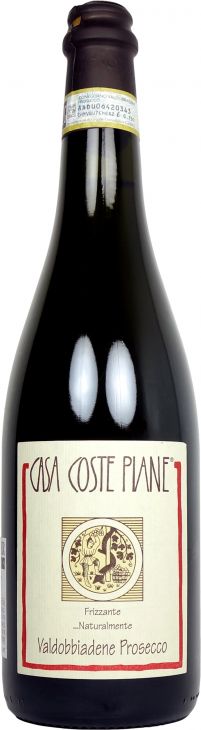
Loris follows a tradition of winemaking that was handed down to him from previous generations without adopting any of the methods and “improvements” that followed the economic boom of the 1960’s, but with a certain regard for technological innovation. The grapes are immediately <glossary term="Pressing" title="827">pressed</glossary> using a <glossary term="Pneumatic Press" title="811">pneumatic press</glossary> (a relatively modern invention that is more efficient and allows for cleaner, fresher juice than a <glossary term="Manual Press" title="1200">vertical press</glossary>). The <glossary term="Must" title="700">must</glossary> is then partially <glossary term="Fermentation" title="441">fermented</glossary> and the <glossary term="Lees" title="590">lees</glossary> and juice are separated and the <glossary term="Lees" title="590">lees</glossary> cleaned through<span class="zalup"><span> <glossary term="Filtration" title="447">filtration</glossary><span>.</span></span></span> At one time a cloth membrane that resembles a very large tea sack was used, but these days they use a paper membrane. The cleaned juice and <glossary term="Filtration" title="447">filtered</glossary> <glossary term="Lees" title="590">lees</glossary> are reintroduced together in bottle in the late winter and <glossary term="Secondary Fermentation" title="938">referment</glossary> by early to mid-summer, creating its own bead and a carbon dioxide environment that prevents <glossary term="Oxidation" title="754">oxidation</glossary> without the use of<span class="zalup"><span> <glossary term="Sulfites" title="993">sulfur</glossary><span>.</span></span></span> There is no <span class="zalup"><span><glossary term="Disgorgement" title="393">disgorgement</glossary><span>,</span></span></span> so the expired <glossary term="Lees" title="590">lees</glossary> remain in the bottle, adding further complexity but also some cloudiness. The wine can be <glossary term="Decanting" title="381">decanted</glossary> off of the deposit or poured as is with its natural harmless turbidity. Either way, the flavor is unchanged and the <glossary term="Minerality" title="662">minerality</glossary> unmistakable.<br />
<br />
This is a readily drinkable style of very dry <glossary term="Prosecco" title="830">prosecco</glossary> that has backbone, breed and evident <span class="zalup"><span><glossary term="Minerality" title="662">minerality</glossary><span>.</span></span></span></p>
producer visit17.07.2019
Casa Coste Piane Visit
This visit to Casa Coste Piane took place in April, 2012
<p><strong><em>This visit at Casa Coste Piane took place in April, 2012.</em></strong></p>
<p><strong><em>Words by Jules Dressner, photos by Lauren Feldman, Shawn Mead and Ian Becker.</em></strong></p>
<p>Here at Louis/Dressner, we're dedicated to getting as much bang for our buck as we can from these trips. So the plan was to visit Loris Follador of Casa Coste Piane approximately five hours after landing in <span class="zalup"><span><glossary term="Venice" title="1076">Venice</glossary><span>.</span></span></span> So after a nine hour flight, we grabbed the rental cars and it was a two hour drive to the lovely town of <span class="zalup"><span><glossary term="Conegliano" title="327">Conegliano</glossary><span>.</span></span></span> After an hour nap, it was time to drive to the famous village of <span class="zalup"><span><glossary term="Valdobbiadene" title="1067">Valdobbiadene</glossary><span>!</span></span></span> </p>
<p><img src="http://louisdressner.com/uploads/images/article/2019_Jul_17//59/bc/59bc4fcf2e9ee95a33b267377f8229c5.jpg" /><br />
<br />
I was excited, because if there's one thing I drank the most in 2011 (and the first third of 2012), it's Coste Piane. It never fails me, and I drink it almost every opportunity I get. It's gotten so bad that I was recently pulled aside by our <em>Self Consumption Director</em> Eddie Wrinkerman (<strong>S.C.D</strong>), who told me that I needed to leave some for the customers. <br />
<br />
The visit began with Loris heartily greeting us, then almost immediately sitting us down in his dining room to taste <glossary term="Prosecco" title="830">Prosecco</glossary> and eat lunch. </p>
<p><img src="http://louisdressner.com/uploads/images/article/2019_Jul_17//c5/69/c569ae1e83aef1c16f1af324b9f00e54.jpg" /><br />
<br />
Food was not part of the plan, and everyone had just eaten in the anticipation of the visit. Well, everyone except me, who had napped instead (cause I'm smart). So after a 2010 bottle for the <span class="zalup"><span><glossary term="Aperitif" title="112">aperitif</glossary><span>,</span></span></span> a true feast began, which started off with this pan-seared salami on a bed of local Friar's Beard. </p>
<p><img src="http://louisdressner.com/uploads/images/article/2019_Jul_17//19/de/19def52a0e7cede17e2062db2d631395.jpg" /></p>
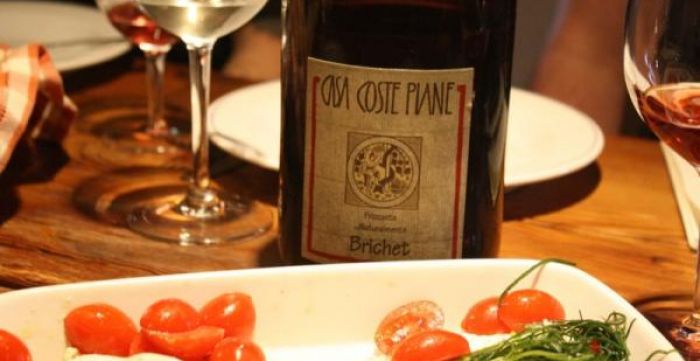
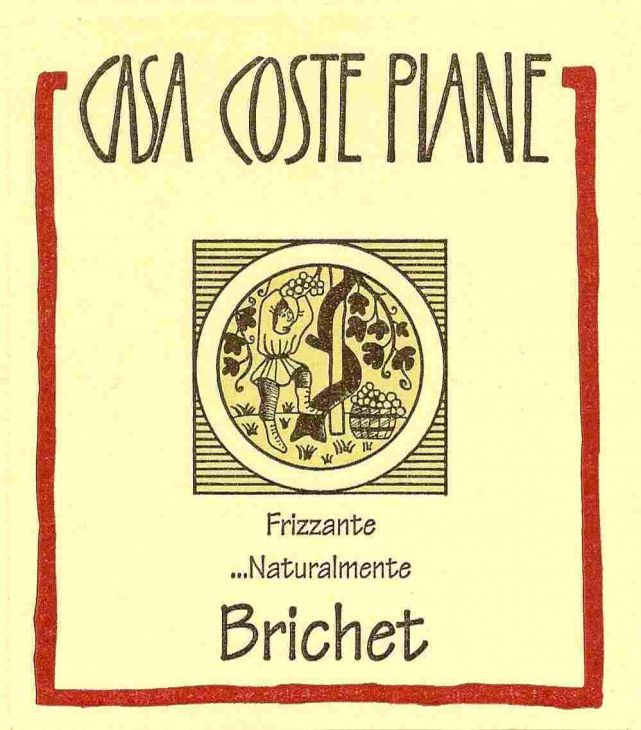
<p>It was delicious. Another fun thing was the opportunity to try Loris' new "Brichet" <span class="zalup"><span><glossary term="Cuvée" title="363">cuvée</glossary><span>.</span></span></span> </p>
<p><img src="http://louisdressner.com/uploads/images/article/2019_Jul_17//5d/6d/5d6daa9dafe7ea43b34c4518a886a6f7.jpg" /><br />
<br />
"Brichet" is a single vineyard of 50+ year old vines just outside of the village. Loris rents them from an old guy who recently retired, and they've been worked <glossary term="Organic" title="746">organically</glossary> for years. The soils are composed of <glossary term="Sand" title="909">sandy</glossary> <glossary term="Limestone" title="596">limestone</glossary> with red <span class="zalup"><span><glossary term="Clay" title="301">clay</glossary><span>.</span></span></span> "Brichet" is just as easy to drink as the base <glossary term="Cuvée" title="363">cuvée </glossary>but a little more structured and with pronounced<span class="zalup"><span> <glossary term="Minerality" title="662">minerality</glossary><span>.</span></span></span> <br />
<br />
Having the group sit down for a meal gave Loris the opportunity to give us some insight on the <span class="zalup"><span><glossary term="Estate" title="427">estate</glossary><span>.</span></span></span> Casa Coste Piane was founded by his grandfather; in those days, all sparkling wine from the village was made completely <span class="zalup"><span><glossary term="Dry/Sec" title="405">dry</glossary><span>,</span></span></span> with a <glossary term="Methode Traditionelle" title="653">méthode traditionelle</glossary> <glossary term="Secondary Fermentation" title="938">secondary fermentation</glossary> in bottle. But at some point in Loris' lifetime, two major changes occured: people began to develop a taste for a much sweeter style of <span class="zalup"><span><glossary term="Prosecco" title="830">Prosecco</glossary><span>,</span></span></span> and <glossary term="Cave Cooperative" title="252">cave cooperatives</glossary> began dominating local production. Today, almost all <glossary term="Prosecco" title="830">Prosecco</glossary> is <glossary term="Chaptalisation" title="270">chaptalized</glossary> and carbonated with the <span class="zalup"><span><glossary term="Charmat" title="272">charmat method</glossary><span>.</span></span></span> <br />
<br />
By the time Loris took over the <glossary term="Estate" title="427">estate</glossary> in the late 1970's, things were taking a turn for the worst. Since most <glossary term="Vigneron/Vignaiolo" title="1089">vigniaoli</glossary> were selling their grapes to a <span class="zalup"><span><glossary term="Cave Cooperative" title="252">coop</glossary><span>,</span></span></span> the more they had to sell the better, which led many to aim for the highest <glossary term="Yield" title="1129">yields</glossary> possible (Loris then explained that <glossary term="Prosecco" title="830">Prosecco</glossary> vines are already incredibly high <span class="zalup"><span><glossary term="Yield" title="1129">yielding</glossary><span>,</span></span></span> and that you really need to act responsibly if you want the juice to retain any complexity). And with the dominance of <glossary term="Industrial Agriculture" title="539">chemical agricultural practices</glossary> that began post-war (which became the norm in the region in the late 1970s early 1980s), <glossary term="Chemicals" title="279">chemical<font color="#000000"><span style="font-weight: 400;"> </span></font></glossary><glossary term="Fertilizer" title="442">fertilizers</glossary> were incredibly popular to beef up<span class="zalup"><span> <glossary term="Yield" title="1129">yields</glossary><span>.</span></span></span> But Loris was unfazed: he's always worked the vineyards <glossary term="Organic" title="746">organically</glossary> and made the wine naturally. When he started, only three producers in <glossary term="Valdobbiadene" title="1067">Valdobbiadene</glossary> worked traditionally. Now there are about 20, which makes him happy. <br />
<br />
After lunch it was time to check out the vines. </p>
<p><img src="http://louisdressner.com/uploads/images/article/2019_Jul_17//b4/ac/b4ac92e509daabde51f1c5dc117a74a5.jpg" /></p>
<p><img src="http://louisdressner.com/uploads/images/article/2019_Jul_17//fb/e7/fbe70a5849593f77996c63ef0ac42fd1.jpg" /></p>
<p><img src="http://louisdressner.com/uploads/images/article/2019_Jul_17//1d/2f/1d2f3f2088a1fddf33fb4d2656d93416.jpg" /></p>
<p>This is what the 60 year old vines look like:</p>
<p><img src="http://louisdressner.com/uploads/images/article/2019_Jul_17//b6/8c/b68c713df34a093c090ad9216a1d37d9.jpg" /></p>
<p><img src="http://louisdressner.com/uploads/images/article/2019_Jul_17//b8/6c/b86c63e5b0155ee05dcc6095ae7723e9.jpg" /><br />
<br />
We also checked out some incredibly beautiful 120 year old vines that are apparently still very productive:</p>
<p><img src="http://louisdressner.com/uploads/images/article/2019_Jul_17//04/57/0457e267cfc71ecb581a48e6c8e24ded.jpg" /></p>
<p><img src="http://louisdressner.com/uploads/images/article/2019_Jul_17//81/03/8103b8a7014476c3064eb80a3887d42f.jpg" /></p>
<p><br />
While most have shifted to intensive<span class="zalup"><span> <glossary term="Monoculture" title="671">monoculture</glossary><span>,</span></span></span> Loris continues to let grass, wild flowers and various root vegetables grow free. Free roaming chickens and ducks hang out in the vineyard. </p>
<p><img src="http://louisdressner.com/uploads/images/article/2019_Jul_17//72/c9/72c9dbecddf6c1816e62ed5ce6cb0b49.jpg" /></p>
<p><img src="http://louisdressner.com/uploads/images/article/2019_Jul_17//41/aa/41aa9232f1b8f7dfdd9edc7115e6686f.jpg" /></p>
<p>Before swinging by the <glossary term="Cellar" title="254">cellar</glossary> to taste the 2011's, Loris had to play with his three month old puppy. </p>
<p><img src="http://louisdressner.com/uploads/images/article/2019_Jul_17//8d/e6/8de623193539c48dcbef4d3540771a48.jpg" /><br />
<img src="http://louisdressner.com/uploads/images/article/2019_Jul_17//ef/b4/efb45e9fa6ac4928bf8f0a844d941c53.jpg" /></p>
<p>He was the softest dog I've ever petted in my life and was adorably cute. The only scary thing was that he was teething and had uber-sharp vampire dog teeth. He was chewing on everything he could (mostly Kevin's shoe and Ian's pant leg).<br />
<br />
In the<span class="zalup"><span> <glossary term="Cellar" title="254">cellar</glossary><span>,</span></span></span> we got to taste the 2011's. As always, the wine is <span class="zalup"><span><glossary term="Direct Press" title="392">direct pressed</glossary><span>,</span></span></span> then <glossary term="Racking/Soutirage" title="843">racked</glossary> to <glossary term="Stainless Steel" title="986">stainless steel</glossary> and cold <glossary term="Fermentation" title="441">fermented</glossary> until completely <span class="zalup"><span><glossary term="Dry/Sec" title="405">dry</glossary><span>.</span></span></span> The wine <glossary term="Fermentation" title="441">ferments</glossary> in about 12 days then settles in <glossary term="Vat/Tank" title="1140">tank</glossary> for four months. A <glossary term="Must" title="700">must</glossary> is then added to the wine and <glossary term="Bottling" title="185">bottled</glossary> immediately, where it <glossary term="Secondary Fermentation" title="938">referments</glossary> in bottle. We tasted the 2011 before the addition of <glossary term="Must" title="700">must</glossary>; the the wine was bright, intensely bright and<span class="zalup"><span> <glossary term="Minerality" title="662">mineral</glossary><span>,</span></span></span> qualities that definitely carry over into the final product. Loris always <glossary term="Bottling" title="185">bottles</glossary> the wine right after Easter (so just a few days ago! Yay!), so that magic <glossary term="Secondary Fermentation" title="938">refermentation</glossary> should be happening as we speak. We ended our visit by drinking two bottles of 2005 to see how the wine <span class="zalup"><span><glossary term="Aging" title="74">ages</glossary><span>.</span></span></span> <br />
<br />
It <glossary term="Aging" title="74">ages</glossary> well.</p>
<p>Loris Follador and his sons Raffaele and Adelchi come from a long line of farmers in <span class="zalup"><span><glossary term="Valdobbiadene" title="1067">Valdobbiadene</glossary><span>.</span></span></span> The family had vines on the steep hillsides when the flat areas of the valley were still pastureland and turnip fields and the main local industry was the nearby pottery and tile factories. Now those flatlands are full of vines, and commercial <glossary term="Prosecco" title="830">prosecco</glossary> with a capital “ P” -that insipid, slightly cloying, and frankly disgusting wine- is the main economy of the region.</p>
<p>Thanks to his father and grandfather, Loris and his two sons have never had to plant a vine. This is a good thing because their vineyards are absurdly steep and the soil is very shallow, hitting solid <glossary term="Limestone" title="596">limestone</glossary> or <glossary term="Sandstone" title="910">sandstone</glossary> rock in a few centimeters. As a result, the vines are all 60 years or older, planted in high <glossary term="Pergola" title="774">pergola</glossary> on steep hillsides. In high season, the vineyards give the impression of a primaeval vine forest. The Folladors are well aware of this fortunate legacy and treat it with the reverence and respect it deserves. No <span class="zalup"><span><glossary term="Herbicide" title="526">herbicides</glossary><span>,</span></span></span> <glossary term="Pesticide" title="1142">pesticides</glossary> or <glossary term="Fertilizer" title="442">fertilizers</glossary> are used. It’s impossible to <glossary term="Plowing" title="810">plow</glossary> here, but it’s really not necessary with vines of this age; they’ve long ago found their sources deep within the stone formation below and are not in competition with any surface vegetation. The harvesting is, of course, <glossary term="Hand Harvesting" title="520">by hand</glossary> and would seem, especially in the steepest spots, near impossible. Most importantly, the focus on the <glossary term="Vinification" title="1104">vinification</glossary> and the <glossary term="Cellar" title="254">cellar</glossary> work is to express, as simply and directly as possible, the potential <glossary term="Minerality" title="662">minerality</glossary> and the <glossary term="Terroir" title="1026">terroir</glossary> of these vines.<br />
<br />
Loris follows a tradition of winemaking that was handed down to him from previous generations without adopting any of the methods and “improvements” that followed the economic boom of the 1960’s, but with a certain regard for technological innovation. The grapes are immediately <glossary term="Pressing" title="827">pressed</glossary> using a <glossary term="Pneumatic Press" title="811">pneumatic press</glossary> (a relatively modern invention that is more efficient and allows for cleaner, fresher juice than a <glossary term="Manual Press" title="1200">vertical press</glossary>). The <glossary term="Must" title="700">must</glossary> is then partially <glossary term="Fermentation" title="441">fermented</glossary> and the <glossary term="Lees" title="590">lees</glossary> and juice are separated and the <glossary term="Lees" title="590">lees</glossary> cleaned through<span class="zalup"><span> <glossary term="Filtration" title="447">filtration</glossary><span>.</span></span></span> At one time a cloth membrane that resembles a very large tea sack was used, but these days they use a paper membrane. The cleaned juice and <glossary term="Filtration" title="447">filtered</glossary> <glossary term="Lees" title="590">lees</glossary> are reintroduced together in bottle in the late winter and <glossary term="Secondary Fermentation" title="938">referment</glossary> by early to mid-summer, creating its own bead and a carbon dioxide environment that prevents <glossary term="Oxidation" title="754">oxidation</glossary> without the use of<span class="zalup"><span> <glossary term="Sulfites" title="993">sulfur</glossary><span>.</span></span></span> There is no <span class="zalup"><span><glossary term="Disgorgement" title="393">disgorgement</glossary><span>,</span></span></span> so the expired <glossary term="Lees" title="590">lees</glossary> remain in the bottle, adding further complexity but also some cloudiness. The wine can be <glossary term="Decanting" title="381">decanted</glossary> off of the deposit or poured as is with its natural harmless turbidity. Either way, the flavor is unchanged and the <glossary term="Minerality" title="662">minerality</glossary> unmistakable.<br />
<br />
This is a readily drinkable style of very dry <glossary term="Prosecco" title="830">prosecco</glossary> that has backbone, breed and evident <span class="zalup"><span><glossary term="Minerality" title="662">minerality</glossary><span>.</span></span></span></p>
Article
producer visit17.07.2019
This visit to Casa Coste Piane took place in April, 2012
<p><strong><em>This visit at Casa Coste Piane took place in April, 2012.</em></strong></p>
<p><strong><em>Words by Jules Dressner, photos by Lauren Feldman, Shawn Mead and Ian Becker.</em></strong></p>
<p>Here at Louis/Dressner, we're dedicated to getting as much bang for our buck as we can from these trips. So the plan was to visit Loris Follador of Casa Coste Piane approximately five hours after landing in <span class="zalup"><span><glossary term="Venice" title="1076">Venice</glossary><span>.</span></span></span> So after a nine hour flight, we grabbed the rental cars and it was a two hour drive to the lovely town of <span class="zalup"><span><glossary term="Conegliano" title="327">Conegliano</glossary><span>.</span></span></span> After an hour nap, it was time to drive to the famous village of <span class="zalup"><span><glossary term="Valdobbiadene" title="1067">Valdobbiadene</glossary><span>!</span></span></span> </p>
<p><img src="http://louisdressner.com/uploads/images/article/2019_Jul_17//59/bc/59bc4fcf2e9ee95a33b267377f8229c5.jpg" /><br />
<br />
I was excited, because if there's one thing I drank the most in 2011 (and the first third of 2012), it's Coste Piane. It never fails me, and I drink it almost every opportunity I get. It's gotten so bad that I was recently pulled aside by our <em>Self Consumption Director</em> Eddie Wrinkerman (<strong>S.C.D</strong>), who told me that I needed to leave some for the customers. <br />
<br />
The visit began with Loris heartily greeting us, then almost immediately sitting us down in his dining room to taste <glossary term="Prosecco" title="830">Prosecco</glossary> and eat lunch. </p>
<p><img src="http://louisdressner.com/uploads/images/article/2019_Jul_17//c5/69/c569ae1e83aef1c16f1af324b9f00e54.jpg" /><br />
<br />
Food was not part of the plan, and everyone had just eaten in the anticipation of the visit. Well, everyone except me, who had napped instead (cause I'm smart). So after a 2010 bottle for the <span class="zalup"><span><glossary term="Aperitif" title="112">aperitif</glossary><span>,</span></span></span> a true feast began, which started off with this pan-seared salami on a bed of local Friar's Beard. </p>
<p><img src="http://louisdressner.com/uploads/images/article/2019_Jul_17//19/de/19def52a0e7cede17e2062db2d631395.jpg" /></p>
<p>It was delicious. Another fun thing was the opportunity to try Loris' new "Brichet" <span class="zalup"><span><glossary term="Cuvée" title="363">cuvée</glossary><span>.</span></span></span> </p>
<p><img src="http://louisdressner.com/uploads/images/article/2019_Jul_17//5d/6d/5d6daa9dafe7ea43b34c4518a886a6f7.jpg" /><br />
<br />
"Brichet" is a single vineyard of 50+ year old vines just outside of the village. Loris rents them from an old guy who recently retired, and they've been worked <glossary term="Organic" title="746">organically</glossary> for years. The soils are composed of <glossary term="Sand" title="909">sandy</glossary> <glossary term="Limestone" title="596">limestone</glossary> with red <span class="zalup"><span><glossary term="Clay" title="301">clay</glossary><span>.</span></span></span> "Brichet" is just as easy to drink as the base <glossary term="Cuvée" title="363">cuvée </glossary>but a little more structured and with pronounced<span class="zalup"><span> <glossary term="Minerality" title="662">minerality</glossary><span>.</span></span></span> <br />
<br />
Having the group sit down for a meal gave Loris the opportunity to give us some insight on the <span class="zalup"><span><glossary term="Estate" title="427">estate</glossary><span>.</span></span></span> Casa Coste Piane was founded by his grandfather; in those days, all sparkling wine from the village was made completely <span class="zalup"><span><glossary term="Dry/Sec" title="405">dry</glossary><span>,</span></span></span> with a <glossary term="Methode Traditionelle" title="653">méthode traditionelle</glossary> <glossary term="Secondary Fermentation" title="938">secondary fermentation</glossary> in bottle. But at some point in Loris' lifetime, two major changes occured: people began to develop a taste for a much sweeter style of <span class="zalup"><span><glossary term="Prosecco" title="830">Prosecco</glossary><span>,</span></span></span> and <glossary term="Cave Cooperative" title="252">cave cooperatives</glossary> began dominating local production. Today, almost all <glossary term="Prosecco" title="830">Prosecco</glossary> is <glossary term="Chaptalisation" title="270">chaptalized</glossary> and carbonated with the <span class="zalup"><span><glossary term="Charmat" title="272">charmat method</glossary><span>.</span></span></span> <br />
<br />
By the time Loris took over the <glossary term="Estate" title="427">estate</glossary> in the late 1970's, things were taking a turn for the worst. Since most <glossary term="Vigneron/Vignaiolo" title="1089">vigniaoli</glossary> were selling their grapes to a <span class="zalup"><span><glossary term="Cave Cooperative" title="252">coop</glossary><span>,</span></span></span> the more they had to sell the better, which led many to aim for the highest <glossary term="Yield" title="1129">yields</glossary> possible (Loris then explained that <glossary term="Prosecco" title="830">Prosecco</glossary> vines are already incredibly high <span class="zalup"><span><glossary term="Yield" title="1129">yielding</glossary><span>,</span></span></span> and that you really need to act responsibly if you want the juice to retain any complexity). And with the dominance of <glossary term="Industrial Agriculture" title="539">chemical agricultural practices</glossary> that began post-war (which became the norm in the region in the late 1970s early 1980s), <glossary term="Chemicals" title="279">chemical<font color="#000000"><span style="font-weight: 400;"> </span></font></glossary><glossary term="Fertilizer" title="442">fertilizers</glossary> were incredibly popular to beef up<span class="zalup"><span> <glossary term="Yield" title="1129">yields</glossary><span>.</span></span></span> But Loris was unfazed: he's always worked the vineyards <glossary term="Organic" title="746">organically</glossary> and made the wine naturally. When he started, only three producers in <glossary term="Valdobbiadene" title="1067">Valdobbiadene</glossary> worked traditionally. Now there are about 20, which makes him happy. <br />
<br />
After lunch it was time to check out the vines. </p>
<p><img src="http://louisdressner.com/uploads/images/article/2019_Jul_17//b4/ac/b4ac92e509daabde51f1c5dc117a74a5.jpg" /></p>
<p><img src="http://louisdressner.com/uploads/images/article/2019_Jul_17//fb/e7/fbe70a5849593f77996c63ef0ac42fd1.jpg" /></p>
<p><img src="http://louisdressner.com/uploads/images/article/2019_Jul_17//1d/2f/1d2f3f2088a1fddf33fb4d2656d93416.jpg" /></p>
<p>This is what the 60 year old vines look like:</p>
<p><img src="http://louisdressner.com/uploads/images/article/2019_Jul_17//b6/8c/b68c713df34a093c090ad9216a1d37d9.jpg" /></p>
<p><img src="http://louisdressner.com/uploads/images/article/2019_Jul_17//b8/6c/b86c63e5b0155ee05dcc6095ae7723e9.jpg" /><br />
<br />
We also checked out some incredibly beautiful 120 year old vines that are apparently still very productive:</p>
<p><img src="http://louisdressner.com/uploads/images/article/2019_Jul_17//04/57/0457e267cfc71ecb581a48e6c8e24ded.jpg" /></p>
<p><img src="http://louisdressner.com/uploads/images/article/2019_Jul_17//81/03/8103b8a7014476c3064eb80a3887d42f.jpg" /></p>
<p><br />
While most have shifted to intensive<span class="zalup"><span> <glossary term="Monoculture" title="671">monoculture</glossary><span>,</span></span></span> Loris continues to let grass, wild flowers and various root vegetables grow free. Free roaming chickens and ducks hang out in the vineyard. </p>
<p><img src="http://louisdressner.com/uploads/images/article/2019_Jul_17//72/c9/72c9dbecddf6c1816e62ed5ce6cb0b49.jpg" /></p>
<p><img src="http://louisdressner.com/uploads/images/article/2019_Jul_17//41/aa/41aa9232f1b8f7dfdd9edc7115e6686f.jpg" /></p>
<p>Before swinging by the <glossary term="Cellar" title="254">cellar</glossary> to taste the 2011's, Loris had to play with his three month old puppy. </p>
<p><img src="http://louisdressner.com/uploads/images/article/2019_Jul_17//8d/e6/8de623193539c48dcbef4d3540771a48.jpg" /><br />
<img src="http://louisdressner.com/uploads/images/article/2019_Jul_17//ef/b4/efb45e9fa6ac4928bf8f0a844d941c53.jpg" /></p>
<p>He was the softest dog I've ever petted in my life and was adorably cute. The only scary thing was that he was teething and had uber-sharp vampire dog teeth. He was chewing on everything he could (mostly Kevin's shoe and Ian's pant leg).<br />
<br />
In the<span class="zalup"><span> <glossary term="Cellar" title="254">cellar</glossary><span>,</span></span></span> we got to taste the 2011's. As always, the wine is <span class="zalup"><span><glossary term="Direct Press" title="392">direct pressed</glossary><span>,</span></span></span> then <glossary term="Racking/Soutirage" title="843">racked</glossary> to <glossary term="Stainless Steel" title="986">stainless steel</glossary> and cold <glossary term="Fermentation" title="441">fermented</glossary> until completely <span class="zalup"><span><glossary term="Dry/Sec" title="405">dry</glossary><span>.</span></span></span> The wine <glossary term="Fermentation" title="441">ferments</glossary> in about 12 days then settles in <glossary term="Vat/Tank" title="1140">tank</glossary> for four months. A <glossary term="Must" title="700">must</glossary> is then added to the wine and <glossary term="Bottling" title="185">bottled</glossary> immediately, where it <glossary term="Secondary Fermentation" title="938">referments</glossary> in bottle. We tasted the 2011 before the addition of <glossary term="Must" title="700">must</glossary>; the the wine was bright, intensely bright and<span class="zalup"><span> <glossary term="Minerality" title="662">mineral</glossary><span>,</span></span></span> qualities that definitely carry over into the final product. Loris always <glossary term="Bottling" title="185">bottles</glossary> the wine right after Easter (so just a few days ago! Yay!), so that magic <glossary term="Secondary Fermentation" title="938">refermentation</glossary> should be happening as we speak. We ended our visit by drinking two bottles of 2005 to see how the wine <span class="zalup"><span><glossary term="Aging" title="74">ages</glossary><span>.</span></span></span> <br />
<br />
It <glossary term="Aging" title="74">ages</glossary> well.</p>